Wood Garage Door Staining: The Complete Guide
On a street-facing home, the garage door is frequently the largest single wood surface in the curb view after the fence — and unlike the fence, it sits at the center of the facade where every visitor’s eye lands. When it fades, the whole house reads older than it is. Restoring it is one of the highest-impact small projects available, and it is genuinely different work from staining a fence.
Why Garage Doors Are Their Own Category
Three things separate door work from fence work. First, scrutiny: a garage door is viewed up close, straight on, in full daylight, by everyone who arrives — flaws that vanish across two hundred feet of fence glare on a door panel. Second, geometry: doors combine flat panels, raised profiles, recessed grooves, stiles, rails, and often decorative hardware, each requiring different application attention and each a place for finish to pool or thin. Recessed grooves and panel corners in particular collect finish if the applicator is generous, and those pools cure glossy and uneven against the flat panel faces around them — one of the most common tells of a rushed door job, and entirely preventable with thin coats and a dry brush working the profiles out. Third, exposure: most garage doors face the street with no shade whatsoever, and pale driveways reflect additional heat and UV back onto them, making the door one of the hardest-exposed surfaces on the property. A west-facing garage door above a pale concrete apron is, in practical terms, receiving something close to a doubled UV dose — direct load from above and reflected load from below — which is why doors that were finished at the same time as a fence routinely need attention a full cycle earlier.
Assessing What You Have
Wood garage doors come in several constructions, and the assessment matters before any product is chosen. Solid wood doors — cedar, mahogany, or fir — take stain fully and restore beautifully. Wood-overlay doors carry a real wood skin over an insulated core, which stains normally but requires care at edges and seams where the overlay meets the substrate. Faux-wood composite and steel doors with printed grain cannot be stained at all, and telling them apart is worth doing before ordering product — a magnet on the surface answers the steel question in a second. Then condition: chalky, faded finish, gray edges, water staining along the bottom rail, and any delamination or swelling at panel bottoms, which is the most common failure point.
The Prep Difference
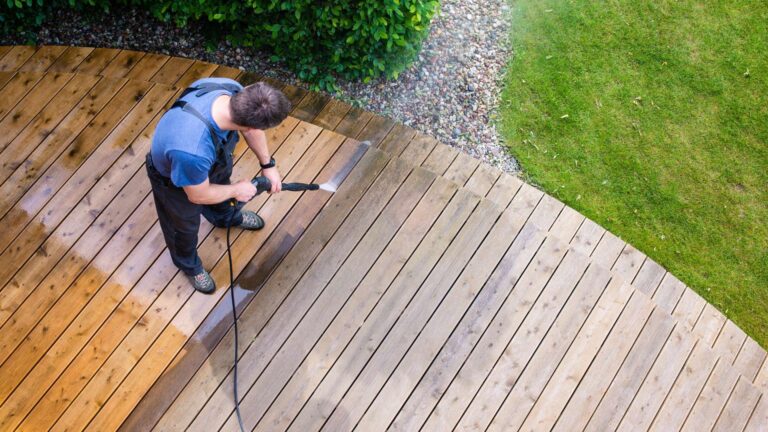
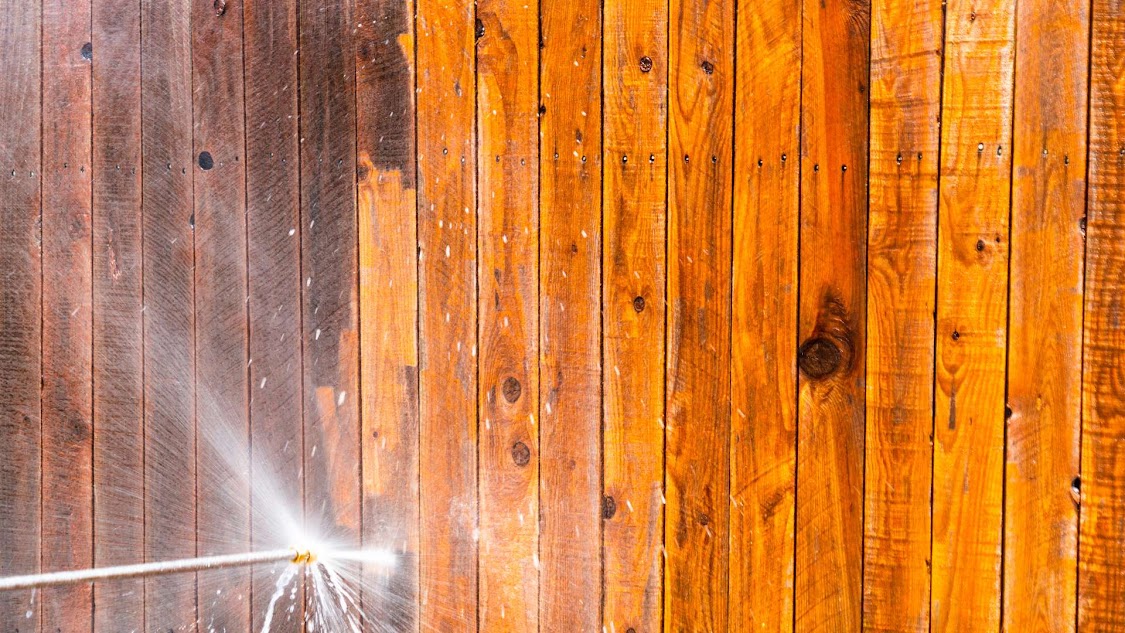
Door prep is more surgical than fence prep and rarely involves pressure washing at all. High pressure near panel seams, weatherstripping, and hardware drives water where it should not go — into the door’s core, behind overlays, into mechanism housings. The standard sequence is hand-scale: clean with a wood cleaner and soft brush, address any mildew chemically, rinse gently, and brighten where gray has established, which is what reverses oxidation rather than merely cleaning it. Failed old finish requires mechanical attention — scraping and sanding to sound material, feathering edges so transitions do not telegraph through the new coat. Hardware, glass, and weatherstripping get masked properly, because overspray on a door is immediately visible.
Product Choice for Doors
Doors want more protection than fences, and often a different finish character. The exposure argues for real pigment — a clear-finished garage door in Austin sun is a short-cycle commitment on a highly visible surface. Many doors also take a marine-grade or spar-type exterior finish, which carries UV inhibitors and flexibility suited to a surface that heats, cools, and moves daily on its tracks. Where the goal is matching an existing entry door or trim, sampling matters even more than usual, since the door will be compared side by side with adjacent millwork in the same light. And whatever goes on, thin coats applied in the panel-then-frame order prevent the runs and pooling that raised profiles invite.
Working Around a Moving Object
A garage door is machinery, which introduces constraints no fence has. The door must be worked in a position that allows access to all surfaces without finishing it into its own tracks or seals. It cannot be operated during cure, which means coordinating with the household’s actual comings and goings — a genuine scheduling conversation rather than an afterthought. Weatherstripping and seals must stay clean, since finish on rubber degrades it and looks poor. Rollers, hinges, and springs stay masked and untouched. And the bottom rail, which sits closest to reflected driveway heat and takes splash from every rain, deserves the extra pass that its accelerated wear justifies.
Coordinating the Whole Street-Facing Package
A garage door rarely looks wrong in isolation — it looks wrong relative to what surrounds it, which is both the risk and the opportunity. Restore a door on a facade where the entry door, shutters, and window trim have all faded together, and the fresh door can make its neighbors look worse than before the project. The efficient approach treats the street-facing wood as one package: door, entry surround, shutters, any decorative brackets or beams, and the fence line where it meets the front yard, finished in coordinated tones during a single mobilization. That coordination costs less than the same items done separately, produces a facade that reads as designed rather than patched, and eliminates the common outcome where a homeowner finishes one element and immediately sees three more. When budget forces sequencing, run it front to back — the door and entry first, since they carry the most attention per square foot.
How the Finish Holds Up, and What Maintenance Looks Like
Given the exposure, expect a garage door to run a maintenance interval on the shorter side of what a fence would — the combination of unshaded southern or western orientation and driveway reflection is punishing, and the door’s visibility means owners notice depletion sooner than they would on a side fence. The maintenance itself is easy: wash gently, check the beading, and re-coat before the finish fails visibly, since a door that has grayed at the edges needs the full prep sequence again. Pairing the door with the property’s other specialty wood work — shutters, entry surrounds, gates — into a single visit is how most households keep the whole street-facing package current without booking four separate projects.
FAQs
Can any wood garage door be stained?
Solid wood and real-wood overlay doors, yes. Faux-wood composites, vinyl, and steel with printed grain cannot take stain — identify the construction before buying product.
Does the door have to come off?
No. Doors are finished in place, positioned for access, with hardware and seals masked. Removal would create more problems than it solves.
How long before I can use the door again?
Through the product’s cure window — typically a day or more depending on finish and weather. This is the main scheduling constraint, and it is worth planning around honestly.
Can I match the garage door to my front door?
Often closely. Different woods take pigment differently, so sample on the actual door rather than trusting a name — and evaluate the samples side by side in daylight.
Why is the bottom of my door worse than the top?
Splash from rain, reflected driveway heat, and proximity to standing water. The bottom rail is the door’s first failure point and deserves extra attention every cycle.
Is pressure washing safe on a garage door?
Generally no. Hand cleaning avoids driving water into seams, cores, and mechanisms. Doors are the clearest case on the property for chemistry over pressure.
How often will it need refinishing?
Shorter intervals than a fence, given the exposure — plan on watching it more closely and re-coating before visible failure, which keeps each cycle to a simple refresh.
Does staining protect the door’s mechanism or just the wood?
The wood only — hardware, springs, and rollers have their own maintenance needs. A finishing visit is a convenient moment to notice mechanical issues, but it does not address them.