Restore or Replace? The Honest Fence Decision Guide
Every weathered fence eventually puts its owner at the same fork: bring it back, or tear it out and start over. The decision is worth getting right, because the two paths differ enormously in cost, disruption, and outcome — and because the industry’s advice is structurally biased, since most of the people offering opinions sell one of the two answers. Here is the honest framework, from a company that only does one side of it and says so up front.
The Principle That Sorts Everything
One distinction does most of the work: surface conditions restore; structural failures do not. Gray color, rough texture, dried-out boards, faded or failed finish, mildew, dirt — all surface, all reversible through washing, brightening, and refinishing. Rotted posts, crumbling board bottoms, failed rails, leaning runs — structural, and no finish fixes them. Most weathered fences frighten their owners with dramatic surface conditions while remaining structurally ordinary underneath, which is why the gray fence that looks hopeless usually is not, and why the decision starts with an inspection rather than an impression.
The Ten-Minute Inspection
Walk the fence with three tests. Push test: lean moderate pressure against posts and panels — solid posts barely move; a run that sways from hand pressure has post or rail problems that finishing cannot address. Probe test: press a screwdriver into the suspects — board bottoms, post bases at the soil line, rail ends. Sound wood resists; rot yields softly. Probe hard at the ground line especially, because posts fail from the soil up and hide it. Count test: tally the boards that fail probing or are visibly broken, and note whether failures cluster (one bad drainage zone, one tree-drip line) or scatter. Ten minutes, three tests, and the fence has told you which conversation you are in.
When Restoration Wins
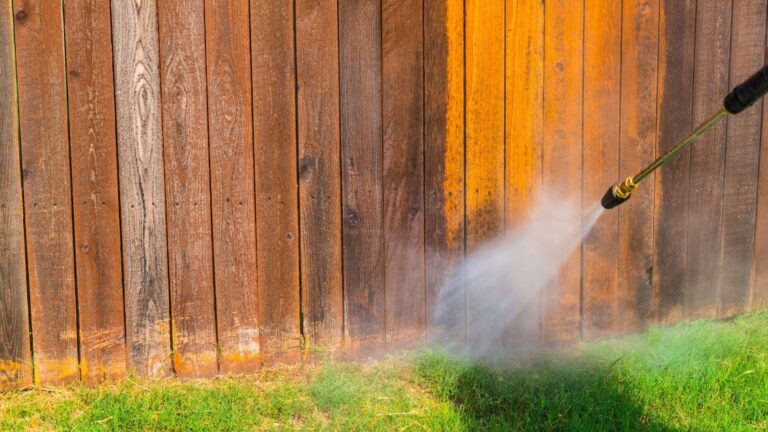
Restoration is the right call — and the dramatically cheaper one — when the structure passes: posts solid, rails sound, failed boards under roughly ten to fifteen percent and replaceable individually. That describes the large majority of gray fences we assess, including decades-old cedar the owners had mentally buried. The restoration sequence — wash, brighten, replace the scattered failures, refinish — returns a fence like that for a fraction of reconstruction cost, with days of disruption instead of weeks, and the finished result carries an advantage new fences cannot: aged, tight-grained cedar under a fresh semi-transparent finish has a depth of character fresh lumber needs years to earn.
When Replacement Wins
Replacement earns its price in specific, recognizable situations. Post failure at scale: when multiple posts probe soft at the ground line, the fence’s skeleton is going, and rebuilding on rotten posts by attaching new boards is money spent twice. Board failure past the ratio: when every third board fails the probe, per-board replacement math collapses and the run is done. Chronic ground-contact designs: fences built with boards buried in soil or grade piled against them will re-rot on schedule; replacement is the chance to fix the design. Layout changes: if the fence line itself is moving — new gate, different height, property changes — restoration preserves the wrong fence. And genuine end-of-material life: wood so dried and checked that boards split at fastening has finished its service regardless of appearance.
The Mixed Verdict Most Fences Actually Get
Real fences rarely vote unanimously. The common inspection result is a mixed verdict: forty feet of sound fence, one failing section by the drainage swale, a tired gate. The efficient answer is usually surgical — rebuild the failed section, restore everything else, finish the whole line together so the repair disappears into a uniform result. This is where owning the whole decision framework pays: knowing that sections can be sentenced individually keeps one bad zone from buying a whole-property replacement, and keeps a mostly-sound fence from limping on around a genuinely failed stretch. The finish coat is the unifier — new section, restored sections, and replaced boards all reading as one deliberate fence. Timing the mixed verdict has its own logic: carpentry first, always — section rebuilds and board replacements happen before any washing or finishing, so new wood weathers briefly alongside old and the finish coat goes on over a settled, complete structure. Reversing the order means finishing twice or matching finishes across a repair seam, both of which cost more than sequencing correctly the first time.
The Economics, Stated Plainly
Without naming numbers that vary by fence: restoration typically runs a fraction of replacement cost — commonly cited across the industry as a quarter to half — while extending a sound fence’s service by many years and preserving landscaping, hardscape, and property lines that reconstruction disturbs. Replacement costs multiples but resets the entire lifecycle, and it is the only honest answer where structure has failed. The trap to avoid sits in the middle: heavy spending on a structurally failing fence (repeated repairs, finish over rot) buys the cost of restoration without its lifespan. The framework’s whole purpose is keeping every dollar on the correct side of that line — and what restoration actually costs depends on condition and scale, which the same inspection reveals.
Whose Advice to Trust
Bias mapping matters in this decision more than most. Fence builders profit from replacement; their assessments skew accordingly, sometimes honestly, sometimes reflexively. Finishing companies profit from restoration and skew the other way — including, in principle, the one writing this. The correctives: get the inspection logic above into your own hands, because the push and probe tests require no expertise; ask any assessor to show you the specific failures driving their recommendation, board by board and post by post; and weigh silence as information — an assessor who cannot point to structural failure while recommending replacement has recommended their invoice. A fence that passes the tests deserves restoration pricing before anyone prices its funeral. The most useful sentence to carry into any assessment conversation: ‘show me the failure.’ It is not adversarial — good contractors on both sides answer it happily and specifically — and it converts every recommendation from an opinion about your fence into a tour of it, which is the only format in which this decision should ever be made.
FAQs
My fence is 20 years old. Is that automatically replacement age?
No — age is not a verdict, condition is. Twenty-year cedar with sound posts restores beautifully; the inspection, not the birthday, decides.
How many bad boards are too many?
The working ratio: past roughly ten to fifteen percent failing, price both paths before committing. Below that, per-board replacement inside a restoration is routine.
Can a leaning fence be restored?
Leaning is structural until proven otherwise — usually a post issue. Individual posts can be reset or replaced within a restoration; systemic post failure votes for rebuilding.
Is it worth restoring a fence I might replace in five years anyway?
Often yes: restoration’s cost is small enough that five good-looking, protected years typically justify it — and restored fences have a way of postponing their own replacements.
Can I replace boards myself and have the finish done professionally?
Common and sensible. Do the carpentry on your schedule; the finishing visit unifies old and new boards into one result.
Does restoration add value if I’m selling?
Disproportionately — the fence line dominates exterior photos and buyer first impressions, and restoration delivers replacement-grade curb impact at maintenance-tier cost.
What if the inspection is beyond me?
Ask for one with the recommendation attached to evidence: which posts, which boards, shown to you directly. Any honest assessor, on either side of the trade, will walk it with you.