How Long Should a Cedar Fence Last in Texas?
Cedar earns its price on a promise of longevity, and the promise is real — but the range is enormous. The same cedar fence lasts twelve years or thirty depending on decisions that have nothing to do with the lumber yard: how it was built, whether it was finished, and what happened in the years between. Here is the honest lifespan math for Central Texas, and where the long end of the range actually comes from.
The Baseline Numbers
Unfinished, unmaintained cedar in the Texas climate typically delivers twelve to fifteen years of structural service — the wood’s natural oils and rot resistance doing all the work alone, with the surface graying in year one or two and the slow drying-and-checking arc following. The same fence finished on schedule and maintained on rhythm routinely reaches twenty to twenty-five years, and well-built, well-kept cedar passing thirty is not rare. The spread is the story: cedar’s genetics buy the first dozen years, and everything after that is purchased by care. Notably, the failure point is rarely the pickets — it is almost always posts at the ground line, which is why lifespan planning starts below the soil.
What Kills Cedar Fences, In Order
Rank the actual causes of death and the maintenance priorities write themselves. First: post failure — moisture at the soil line rotting posts from the ground up, the failure mode that takes down structurally healthy fences whose boards had years left. Second: moisture cycling — unsealed boards swelling and shrinking through storm-and-drought cycles until checking, cupping, and fastener failure accumulate. Third: UV degradation — sun breaking down surface fibers year over year, the process that turns gray cosmetic damage into dry, brittle, structural weakness over a decade. Fourth, and most preventable: ground contact and grade problems — boards touching soil, mulch piled against the fence line, sprinklers watering the pickets daily. Insects and storms take individual fences; those four take the population.
The Finish Question, Settled by Arithmetic
Whether cedar ‘needs’ staining is a forum debate; the lifespan arithmetic is not. A finish addresses killers two and three directly — pigment absorbing the UV, the sealed surface shedding the moisture — which is why the finished-fence range runs roughly double the bare-fence range. The natural-oils argument holds exactly as far as the baseline numbers: cedar unprotected outlasts pine unprotected, and both weather on schedules that finishing dramatically extends. How long any given stain protects runs its own three-to-five-year cycle within the fence’s larger arc — the fence’s lifespan is, in a real sense, the sum of the finish cycles someone bothered to maintain.
Construction Decisions That Set the Ceiling
Some lifespan is decided before any finish opens. Posts: properly set posts — adequate depth, correct concrete work, drainage-conscious — are the difference between a fence that reaches its wood’s potential and one that fails at year twelve with beautiful pickets. Ground clearance: boards held off the soil resist the wicking that rots picket bottoms. Fastener quality: cheap fasteners streak, corrode, and loosen years before good ones. Grain and grade of the lumber itself: tight-grained, better-grade cedar simply has more material integrity to spend. None of this is finishing-company territory — we inherit these decisions rather than make them — but a restoration assessment reads them constantly, because they explain why two same-age fences on one street can deserve opposite verdicts.
The Maintenance Rhythm That Buys the Long End
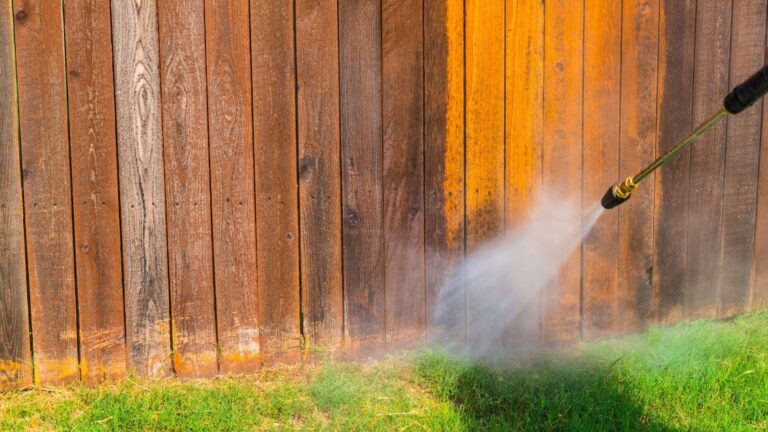
The twenty-five-year cedar fence is not lucky; it is scheduled. The rhythm: a first finish timed to the new wood’s moisture readiness; an annual wash keeping buildup off the finish and doubling as inspection; the water-bead test each spring and fall; a maintenance coat each time the sunniest face fails the test — the standard three-to-five-year cycle; and restoration the one time in mid-life when a lapse lets the gray establish. Add the small physical disciplines — sprinklers redirected off the fence line, grade kept off the boards, vegetation trimmed back — and the schedule reads almost boring. That is the point: cedar longevity is a boring, repeating checklist, and the dramatic fence failures are almost all biographies of skipped checklist years.
The Neighborhood Cohort Effect
Cedar lifespan is easiest to see at street scale, because Austin fences age in cohorts — whole subdivisions fenced the same season, weathering side by side under identical sun. Walk any fifteen-year-old neighborhood and the cohort has visibly split: some runs silver and checking, some rich-toned and tight, all the same age and largely the same lumber. The split maps almost perfectly to maintenance history, and it is the most honest longevity data available anywhere — same climate, same wood, same years, different care. It also carries a practical scheduling insight: when your fence’s cohort starts graying, yours is on the same chemistry clock whether it shows yet or not, and the households that act on the block’s signal rather than waiting for their own tend to stay a full maintenance tier cheaper. The neighbor’s silver fence is not their problem alone; it is your calendar reminder.
Reading a Cedar Fence’s Age Honestly
Assessing where a fence sits in its arc takes minutes. Surface gray with sound wood underneath — probe-resistant boards, solid posts — is early-to-mid arc regardless of calendar age: fully restorable, years of service banked. Checking and dryness that probe still-sound is mid-arc: restoration now buys the most additional life per dollar it will ever buy. Soft board bottoms scattered along the run is late-mid arc: replace the failures, restore the rest, and tighten the maintenance rhythm. Soft posts at the ground line is the arc’s end regardless of how the pickets look — the structural conversation has arrived. The encouraging field reality: most gray Texas cedar the owners assume is dying sits squarely in the first two categories, which is why the assessment is worth having before any replacement math starts.
Cedar vs. the Alternatives, Lifespan Edition
The lifespan lens also clarifies the material comparisons owners weigh at replacement time. Pressure-treated pine: cheaper up front, rot-resistant by treatment rather than nature, and typically a shorter arc than cedar at every maintenance level — narrower where meticulously kept. Composite and vinyl: longer nominal lifespans with no finishing cycle, purchased at multiples of the cost and with repair stories of their own (sections fade, panels crack, and unlike wood, damage is replaced rather than restored). Cedar’s position in that field is the middle path with the highest ceiling per dollar: a natural material whose lifespan is genuinely elastic — stretchable to decades by the boring rhythm this article describes, or spendable in fifteen years of neglect. The material decides the range; the owner picks the point in it.
FAQs
Is cedar worth the premium over pine for a fence?
For longevity, generally yes — cedar’s natural resistance buys real additional years at every maintenance level, and it takes finish more handsomely. Pine narrows the gap when meticulously maintained; cedar forgives more.
My cedar fence is 18 and gray. Is it near the end?
Gray says nothing by itself. Run the probe and push tests: sound posts and firm boards at 18 mean a restorable mid-life fence with real years ahead.
Does staining new cedar too early hurt its lifespan?
Staining before the wood dries to absorption readiness shortchanges the first finish, which underperforms for its whole cycle. Weeks to a couple of months of patience protects decades of arc.
Do cedar fences last longer in shade or sun?
Shade slows UV aging but feeds moisture and mildew; sun reverses the trade. Maintained fences thrive in both; unmaintained ones just fail by different chapters.
How much does the annual wash really add?
It keeps finishes reaching their full cycle and catches every early-failure signal a year sooner — modest effort, compounding return, and the cheapest habit in the entire rhythm.
Can post failure be fixed without replacing the fence?
Individually, yes — single posts reset or sistered within a restoration is routine. Systemic post failure across a run is the honest replacement trigger.
What is the single best thing I can do for a new cedar fence today?
Time its first finish correctly and put the bead test on your calendar. Everything in the long-end arithmetic descends from those two habits.