The Science of Gray: What Weathering Does to Wood
Gray is the most misread signal in exterior wood. Owners see it and conclude the fence is dirty, dying, or done — three different wrong answers that lead to three different wasted expenditures. What gray actually represents is a specific, shallow, well-understood chemical change, and knowing what it is tells you exactly how much of a problem you have. Usually: less than you feared.
What UV Does to Wood, Molecularly
Wood is mostly cellulose and lignin. Cellulose provides structure; lignin is the natural polymer binding fibers together, and it is also what gives wood much of its color. Lignin absorbs ultraviolet light readily, and that absorption breaks it down — photodegradation, in the same family of process that fades fabric and chalks paint. As surface lignin degrades, the freed cellulose fibers scatter light differently, producing the characteristic silver-gray appearance. The degraded lignin byproducts wash away with rain, leaving loose surface fibers behind. That is the entire mechanism: sunlight dismantling the glue at the surface, weather rinsing away the debris.
How Deep It Actually Goes
This is the most useful fact in the article, and the most reassuring: weathering gray is remarkably shallow. On typical outdoor wood, the degraded layer measures a fraction of a millimeter — commonly cited around a hundredth of an inch or so, deepening very slowly over years of exposure. Beneath that paper-thin layer, the wood is chemically unchanged and structurally intact. This is why washing and brightening can reverse decades of visible weathering in an afternoon: the restoration is not rebuilding the wood, it is removing and neutralizing a surface film thinner than a sheet of paper. A twenty-year-gray fence with sound posts is, materially, a sound fence wearing a very thin bad haircut.
The Secondary Effects That Do Matter
Gray itself is cosmetic; what accompanies it is not always. As the surface degrades, wood loses its water repellency, so boards absorb and release moisture more freely — driving the swelling-shrinking cycle that opens checks, cups boards, and works fasteners loose over time. The roughened, porous surface holds dirt and gives mildew a foothold. And with lignin gone at the surface, subsequent UV works slightly deeper each season. So the honest framing is that gray is harmless in itself and a reliable indicator of unprotected wood, which over enough years does produce real degradation — not because of the color, but because of what the color proves about the finish.
Why It Happens Faster in Austin
Central Texas accelerates every part of this. UV intensity here runs high by latitude and by clear-sky days, so the photodegradation dose is simply larger than in cloudier climates. The heat drives the moisture cycling that stresses the weakened surface. And our particular pattern — long dry stretches punctuated by heavy rain — maximizes the swelling-shrinking amplitude that opens checks in degraded wood. Practical effect: fences that would gray over five or six years elsewhere gray noticeably within one or two here, and unprotected wood reaches its silver stage on a timeline that surprises transplants constantly. What the Texas sun does to wood is this process running at high speed.
The Timeline of Weathering, Stage by Stage
Unprotected wood follows a recognizable progression, and locating your structure on it tells you what the project ahead actually is. Stage one, within weeks to a few months: subtle dulling and the first color shift, the finish or fresh-wood brightness fading — nothing dramatic, easily missed. Stage two, within the first year in Austin: distinct graying on sun-facing surfaces, surfaces feeling slightly rough, water beginning to soak rather than bead. Stage three, one to three years: uniform silver on exposed faces, visible surface fiber loosening, the first fine checks opening as unrestrained moisture cycling begins its work. Stage four, three to five-plus years: pronounced checking, splintering on horizontal surfaces, deeper roughness, and mildew establishing in the porous surface. Stage five, many years unprotected: physical degradation beyond the cosmetic — board erosion, deep splits, and the point where restoration stops being purely a finishing project. The encouraging note is how far along that list is still recoverable: stages one through four all restore, which covers the overwhelming majority of gray wood in Austin backyards.
Why Pigment Is the Only Real Defense
Since the mechanism is UV absorption by lignin, the defense is intercepting UV before it reaches lignin — which is precisely what pigment does. This also explains why the same finish performs so differently across one property: a north-facing fence run and a south-facing one receive UV doses that differ by a wide margin, so identical products on identical wood reach their depletion point years apart. Protection is not a property of the can alone — it is the can’s pigment load measured against the dose that particular surface receives. Pigment particles absorb and scatter ultraviolet within the finish layer, so the wood beneath receives a fraction of the dose. This explains the otherwise puzzling hierarchy in finishes: clear sealers protect fully against water and barely at all against graying, semi-transparent stains slow it substantially, and solid stains nearly stop it. It is not that clear products are lower quality; it is that they contain almost none of the one ingredient that addresses this specific mechanism. Anyone choosing a finish for a sun-exposed surface is, in effect, choosing a UV dose.
Reversing It
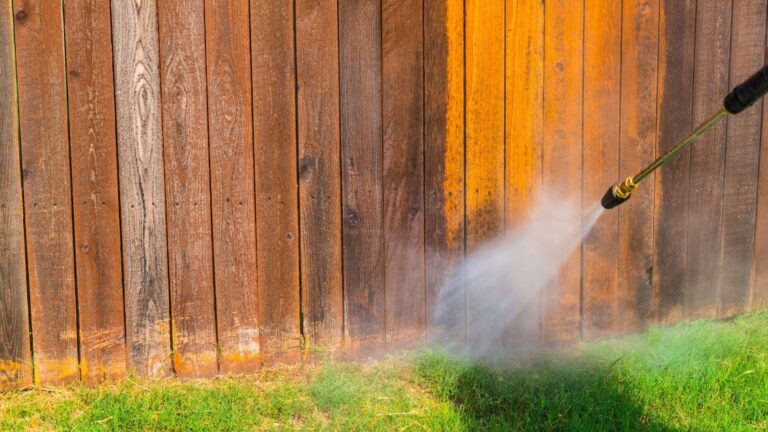
Because the change is shallow and chemical, the reversal is straightforward: washing removes the loose degraded fibers and surface debris, and brightening neutralizes the oxidation chemically, returning the surface toward its original tone within minutes. Then finishing — with pigment this time — protects the freshly exposed sound wood underneath. The results routinely surprise owners who had mentally written the structure off, because the wood revealed is genuinely the wood they remember. The limit worth stating plainly: this reverses weathering, not decay. Gray restores; rot does not, and telling the two apart is the assessment that should precede any restoration decision. One practical corollary worth carrying: because gray is shallow and reversible, the appearance of a weathered fence is almost useless as evidence for replacement. The push and probe tests are the evidence. A silver fence that passes them is a finishing project wearing a frightening costume, and it is worth insisting that any replacement recommendation point to structural failure rather than to color.
FAQs
Does gray wood mean my fence is rotting?
No — they are unrelated processes. Gray is surface UV degradation; rot is fungal decay requiring sustained moisture. Probe the wood: firm under gray means weathering only.
Can I just leave it gray if I like the look?
Many people do, and the driftwood aesthetic is legitimate. Understand the trade: the wood is unprotected, so moisture cycling and checking continue. Pigmented gray stains deliver the look with protection.
How long does it take wood to gray in Austin?
Visible graying often begins within months on unprotected wood and reaches full silver within a year or two — considerably faster than in milder climates.
Will pressure washing remove gray?
Partially — it removes loose degraded fiber, but oxidation is chemical and needs brightening to reverse. Washing alone typically leaves a dull, uneven result.
Does gray wood take stain differently?
Yes, and poorly, until treated — degraded fiber is not a sound bonding surface, and the alkaline state after cleaning worsens absorption. This is why restoration includes brightening before finishing.
Do all woods gray the same way?
The mechanism is universal; the pace and final tone vary. Cedar and redwood gray to a silver, pine tends toward a duller gray, and dense tropical hardwoods gray slowly but do gray.
Is gray wood weaker?
At the immediate surface, marginally. Structurally, no — the degraded layer is far too thin to affect strength. The strength risk comes from years of unchecked moisture cycling, not from the gray itself.