Budgeting Fence Maintenance for Commercial Properties
Wood fencing on a commercial property occupies an awkward budget position: too small to earn capital planning attention, too visible to ignore, and too easy to defer until the deferral becomes a replacement quote. Property managers, HOA boards, and facilities teams who move it from reactive to scheduled spend measurably less over the asset’s life. Here is how that planning actually works.
Why Commercial Wood Fails on a Different Timeline
The physics are identical to residential; the context is not. Commercial fence runs are typically longer, which means more linear feet of exposure and a larger absolute spend whenever something is done. They are often perimeter-facing, so their condition is the property’s first impression for tenants, customers, and prospective buyers. Nobody lives there to notice gradual change, so degradation goes unremarked far longer than it would on a homeowner’s back fence. And the decision-maker is frequently not the person who sees it daily — a gap that turns visible deterioration into a line item nobody raised until it was urgent.
The Two Budget Models
There are only two ways to fund this, and they cost very different amounts. Reactive: nothing is spent until the fence looks bad enough to generate complaints, at which point the work required is a full restoration — heavy prep, brightening, board replacement, and more product on thirsty wood — or, past a certain point, replacement. Scheduled: a modest recurring line funds annual washing and periodic maintenance coats, and the fence never enters the expensive state. Industry-wide, restoration runs a fraction of replacement and a maintenance coat runs a fraction of restoration, so each tier of postponement multiplies the eventual figure. The scheduled model is not merely tidier; it is the cheaper of the two by a wide margin over any multi-year horizon.
Building the Cycle
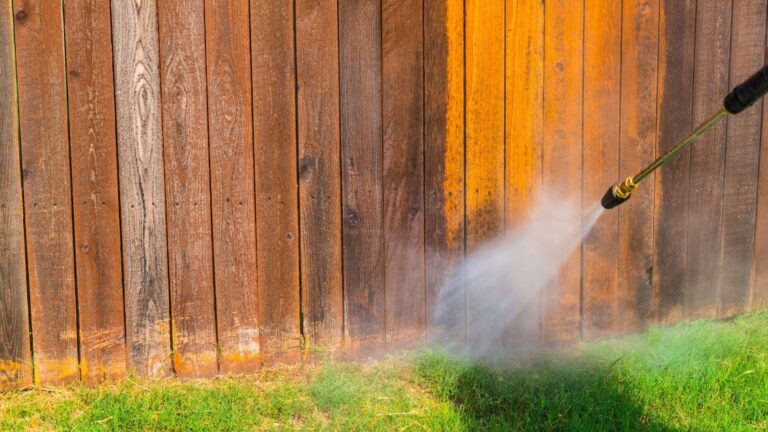
A workable commercial cycle has three components on different intervals. Annual: a professional wash of all wood surfaces, which removes buildup, treats growth, and — critically — produces a condition report. Every three to five years, exposure-dependent: maintenance finishing, ideally zoned so hard-exposure runs are done on their faster clock rather than finishing everything whenever the worst section demands it. As-needed: board and post replacement, identified during the annual wash while the issue is still individual rather than systemic. Layered on top, a documented inspection each year at the same time, so the property has a maintenance history rather than a series of disconnected invoices.
Phasing Large Properties
Sites with substantial fence footage rarely need everything done at once, and phasing is the tool that makes the budget line predictable. Zone the property by exposure and visibility: street-facing and southern or western runs first, since they carry both the impression and the fastest degradation; interior and shaded runs later on their longer clocks. Then distribute the zones across budget years so the line item is level rather than spiking. The efficiency caveat worth knowing: mobilization costs are shared within a visit, so phasing into too many small visits erodes the savings. The practical balance for most large sites is one substantial visit annually, with the zones rotating through it.
What Drives the Number
For anyone building an estimate line, the same factors that price residential work apply at scale: linear footage and height, whether one or both faces are finished, current condition (the largest swing), access and site conditions, and product choice. Commercial sites add a few of their own. Traffic and operational constraints — work that must happen outside business hours or around tenant access — affect scheduling and therefore cost. Security and gate hardware add complexity. Landscaping maintained by another vendor requires coordination. And liability and insurance documentation requirements are standard on commercial work and worth confirming any bidder carries appropriately.
Product Choices That Favor Long Intervals
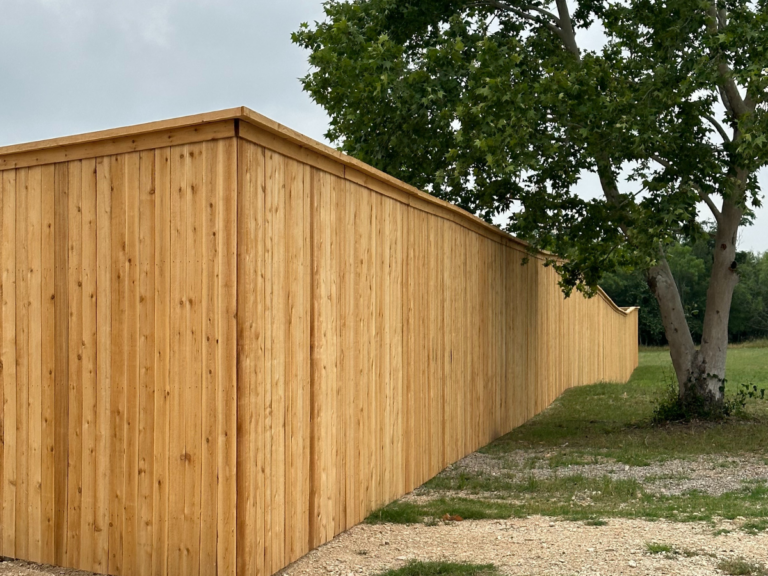
Commercial economics push toward different finishing decisions than residential taste often does. Since the labor and mobilization dominate the cost of any visit, the value lies in maximizing the interval between visits — which argues for heavier pigment. Solid and semi-solid finishes run the longest cycles, deliver uniform appearance across long runs where board variation would otherwise show, and mask the mixed-age wood that accumulates on properties that have replaced sections over time. Uniformity is also a genuine asset commercially: a long fence line in one consistent tone reads as maintained infrastructure, while a variegated semi-transparent run on mixed-age boards reads as patched.
Vendor Selection and Continuity
Commercial fence maintenance rewards continuity with a single vendor in ways one-off residential work does not. A crew returning annually knows the property’s zones, which runs failed last cycle, what product went on and when, and where the access complications are — knowledge that translates directly into faster visits and better-targeted work. Continuity also produces the documentation trail that makes budgeting credible: consistent condition reports year over year, comparable photographs, and a maintenance history that survives staff turnover on both sides. When selecting, the questions worth asking go beyond price: does the vendor provide written condition reports, do they specify prep steps rather than lumping them, can they phase and zone the property intelligently, do they carry appropriate commercial insurance, and can they work within the site’s operational constraints. The lowest bid that treats a long perimeter run as undifferentiated linear footage will spend the same money less effectively than one that zones it — and on a multi-year horizon, effectiveness is the whole game.
Making the Case Internally
Whoever has to justify this line benefits from framing it correctly. It is not aesthetics; it is asset preservation on a depreciating structure with a documented failure mode. The comparison that lands is the tiered one: annual washing, versus periodic finishing, versus restoration, versus replacement — four figures separated by multiples, with the property’s current trajectory determining which one appears in a future budget. Photographs help enormously, particularly year-over-year images of the same run, since gradual change is exactly what decision-makers who visit occasionally cannot perceive. And where the property is tenanted or marketed, the curb-impression argument is legitimate on its own terms: the perimeter is the first thing every visitor evaluates. One more framing that works with finance-minded reviewers: because the tiers are separated by multiples rather than percentages, the maintenance line is best presented as risk reduction against a much larger future capital request. A modest recurring number now is what keeps a replacement quote off a future agenda.
FAQs
How often should commercial wood fencing be washed?
Annually is the standard, and it doubles as the inspection that catches individual issues before they become systemic.
What is a realistic finishing interval for a commercial run?
The same three-to-five-year range as residential, driven by exposure — with zoning so hard-exposure sections are finished on their own faster clock.
Can the work be phased across budget years?
Yes, and it usually should be on large sites. Zone by exposure and visibility, but avoid fragmenting into many small visits, which loses mobilization efficiency.
Does the work have to happen outside business hours?
Depends on the site and the access involved. It is worth specifying in any bid request, since it affects scheduling and cost.
How do we compare bids fairly?
Confirm each specifies the same sides, footage, prep steps, product and coat count, and how board replacement is handled. Prep is where bids diverge most.
Is restoration realistic on a long neglected commercial run?
Usually yes if the posts are sound — the same probe-and-push assessment applies, just repeated along the run. Sections can be sentenced individually.
What documentation should we keep?
Dated condition reports, work performed, products used, and photographs of the same runs each year. It supports budgeting, vendor comparison, and any eventual sale.