Green Fence? Mildew and Algae on Austin Wood
A green film creeping up the shaded side of a fence is one of the most common calls we get in Austin, usually phrased as a cleaning question. It is really a biology question, and the distinction matters: growth that gets scrubbed off returns within weeks, while growth that gets killed properly stays gone for a season or more. Here is what is actually living on your fence, and what makes it leave.
What’s Actually Growing There
Three organisms account for nearly all of it. Algae — the green film — is a plant that needs moisture and light, thriving on the damp shaded faces where wood stays wet longest. Mildew and mold — the black or dark gray spotting and staining — are fungi that need moisture and organic material, and unfinished or depleted wood surfaces supply both. Lichen — the crusty, sometimes pale-green or grayish patches that look almost mineral — is the slowest-growing and most tenacious of the three, an algae-fungus partnership that anchors into the surface. All three are surface organisms on sound wood, which is the good news; all three are also symptoms of a moisture pattern that is not going away on its own.
Why Austin Wood Is So Hospitable
Central Texas seems too hot and dry for this, and that intuition misleads. Our humidity runs high through much of the year, spring and fall bring extended damp stretches, and the shade patterns from live oaks and privacy fencing itself create microclimates where surfaces stay wet for days. Add irrigation — sprinkler heads misting fence lines daily is a leading cause we see constantly — plus the organic dust and pollen load that gives fungi something to eat, and the result is a genuinely favorable habitat on any surface that stays damp. The green fence is not a sign of unusual neglect; it is the default outcome wherever moisture lingers on wood that has lost its protection.
Where It Shows Up First, and Why That’s Informative
Growth patterns are a diagnostic map. North-facing and heavily shaded runs go first, because they dry slowest. The bottom eighteen inches of any fence often shows it, where splash-back and irrigation keep boards damp. Sections under tree canopy accumulate both moisture and organic debris. Areas near downspouts, along drainage paths, and behind shrubs that block airflow are reliable hotspots. Reading the pattern tells you what to fix beyond cleaning: if the growth traces a sprinkler arc, the sprinkler is the problem; if it follows a shrub line, airflow is; if it is general across shaded faces, the finish has simply depleted and the wood is drinking every rain.
Why Bleach Alone Disappoints
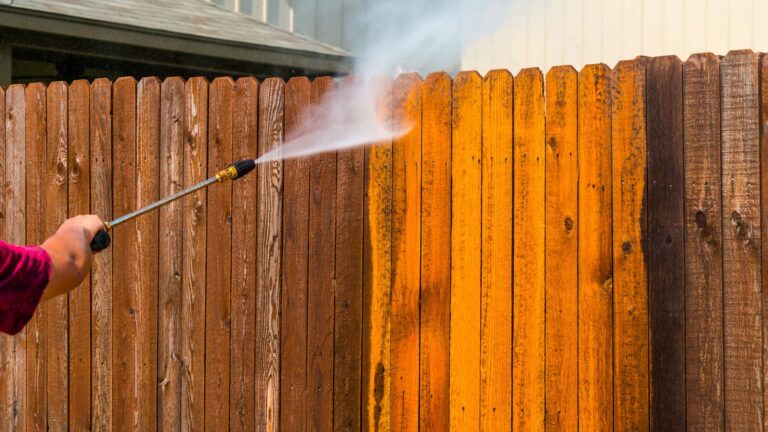
The internet’s standard answer — household bleach and a scrub brush — produces a satisfying result that fails predictably. Bleach lightens the pigment in algae and mildew, which makes the surface look clean while leaving the organism’s root structures intact within the wood’s pores; regrowth follows quickly, often faster than before because the surface is now more porous. Bleach also damages lignin in wood fibers over repeated use, can corrode fasteners, and kills plantings on contact at the concentrations people reach for. Professional treatment uses buffered solutions at controlled dilution with surfactants that let the chemistry penetrate and dwell, killing the growth at its anchors so the rinse actually removes it. The difference shows up not on cleaning day but three months later.
The Treatment That Actually Works
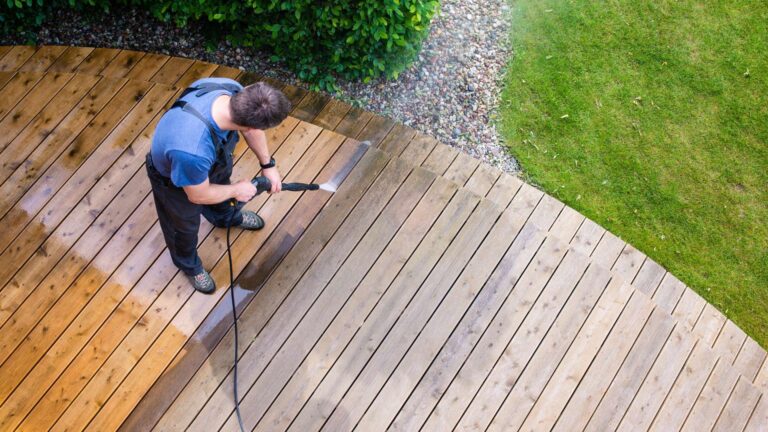
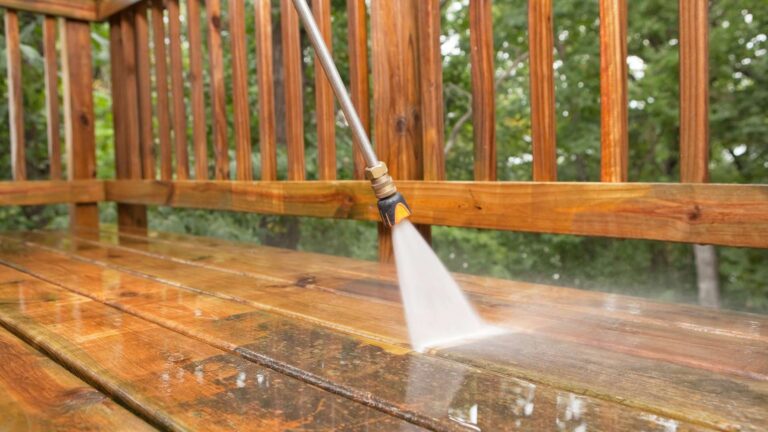
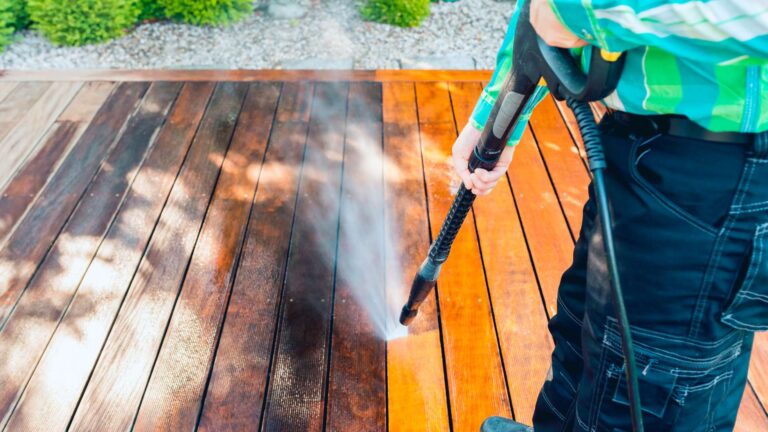
The reliable sequence is chemistry-led and pressure-light. Pre-wet the wood and surrounding plantings. Apply a wood-appropriate cleaning solution with mildewcide from the bottom up to prevent streaking, and let it dwell — the dwell is where the killing happens, and it is the step impatient cleaning skips. Keep the solution live on hot days by misting rather than letting it dry. Then rinse at wood-safe pressure, top down, with a wide fan tip. Where lichen has anchored, expect a second application rather than reaching for more pressure. Wood-safe fence washing is this process practiced as a routine, and the reason pressure is the junior partner is exactly this: force removes what it can see, chemistry removes what it cannot.
Telling Growth From Staining From Gray
Three surface conditions get confused constantly, and treating one as another wastes effort. Living growth — algae, mildew, lichen — has color that is green, black, or crusty, sits on the surface, and often shows a pattern following moisture rather than exposure; a wet finger or a scratch test will smudge or lift young growth. Tannin and rust staining is dark brown or black, runs in streaks and bleeds from fasteners or knots, does not smudge, and needs brightening rather than cleaning, because it lives in the wood. Weathering gray is uniform, silvery, follows sun exposure rather than shade, and covers whole faces evenly; it also needs brightening. The practical significance: a shaded fence face that is dark may be hosting mildew (kill it), stained by tannins (brighten it), or both, while the sunny face on the same fence is gray for an entirely unrelated reason. A correct diagnosis produces one visit that handles everything; a wrong one produces a wash that leaves two-thirds of the problem in place.
Keeping It From Coming Back
Killing the current growth buys a season; changing the conditions buys years. Four interventions do most of the work. Redirect irrigation — fence lines should never be in a sprinkler’s arc, and this single fix resolves more chronic green fences than any product. Improve airflow by trimming shrubs and vines back from the boards, giving surfaces a chance to dry. Restore the finish, because a protected surface sheds water instead of holding it, and depleted finish is why the wood stays damp long enough to host anything. And keep the annual wash on the calendar, since surfaces cleaned before growth establishes never develop the entrenched colonies that require aggressive treatment. Chronic green fences are almost always moisture-management problems wearing a cleaning costume. Worth setting expectations honestly on one point: no treatment makes a fence permanently growth-proof. Spores travel, shade persists, and Austin’s humid stretches return every year. What good practice buys is a surface that resists colonization long enough that annual maintenance stays gentle — the difference between a fence washed once a year at low pressure and one that needs aggressive intervention every spring because the problem was never actually killed.FAQs
FAQs
Is mildew on my fence dangerous?
Surface growth on outdoor wood is primarily a wood-health and appearance issue rather than a household hazard. It does indicate persistent moisture, which is worth fixing for the fence’s sake.
Will the green come back after professional cleaning?
Eventually — spores are everywhere. Properly killed growth typically stays clear a season or considerably longer, versus weeks for bleach-and-scrub, and the moisture fixes above extend that further.
Can I stain over a fence that has mildew on it?
No. Finish applied over living growth traps it, and the growth continues under the coating — a guaranteed early failure. Killing and removing it is mandatory prep.
Does the black staining come out completely?
Usually, though deep tannin staining from long-term growth sometimes needs brightening afterward to fully even the color. Brightening is standard in any restoration sequence anyway.
Are the treatments safe for my plants and pets?
Managed professionally, yes — plantings are pre-wetted and rinsed, solutions run at controlled dilution, and pets stay inside during the work and until surfaces dry.
Why does only one side of my fence have it?
That side dries slower — usually north-facing, shaded, or blocked from airflow. The clean side is telling you what the green side needs.
How soon after treatment can the fence be stained?
After the standard two to three drying days, assuming the wood tests ready. Killing the growth and finishing the wood are naturally sequential parts of one project.