How to Clean a Deck or Fence Before Refinishing
Every finish — stain or paint, premium or budget — makes the same silent assumption: that it is bonding to wood. Not to dust, not to mildew, not to the chalky remains of the last coat. Cleaning is how that assumption gets made true, and choosing the right method for what is actually on the surface is most of the skill.
Why Cleaning Beats Product Upgrades
The refinishing industry sells the opposite story — that better products rescue worse prep — and the price tags follow. The field evidence runs the other way. A mid-tier stain over properly cleaned, brightened, and dried wood consistently outlasts a premium stain over a rushed surface, because no formulation can bond to material that is not there or penetrate grain that is sealed under grime. The budget arithmetic follows: on a typical refinishing project, moving one tier up in product costs real money and buys marginal chemistry, while spending that same amount on thorough prep — the extra wash pass, the brightener, the drying patience — buys the conditions every tier of product needs to perform. Buy prep first. The can’s promises are all written assuming you did.
First, Diagnose the Surface
Wood headed for refinishing carries some mix of five things: loose debris, embedded dirt, biological growth, failing previous finish, and gray oxidized fiber. Each has a method that removes it and methods that merely rearrange it — so the honest first step is a close look and a hand across the boards. What comes back on your palm, what smears green, and where water soaks versus beads is the diagnosis the cleaning plan follows.
Method 1: Calibrated Pressure Washing
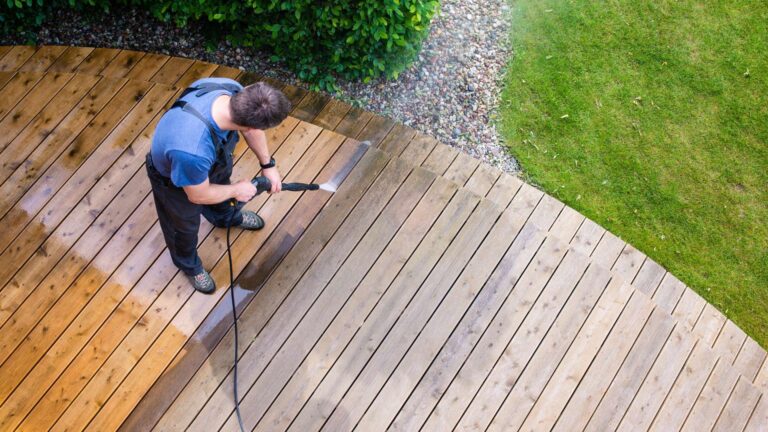
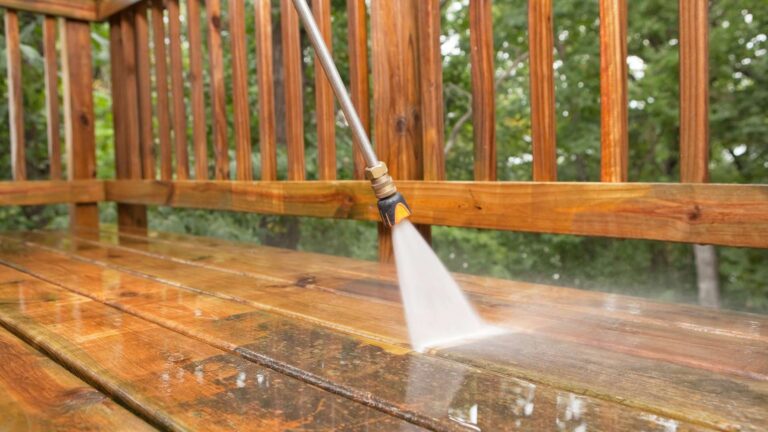
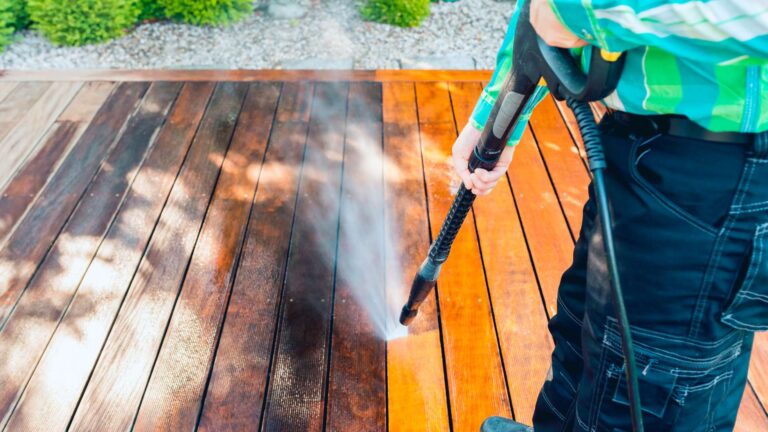
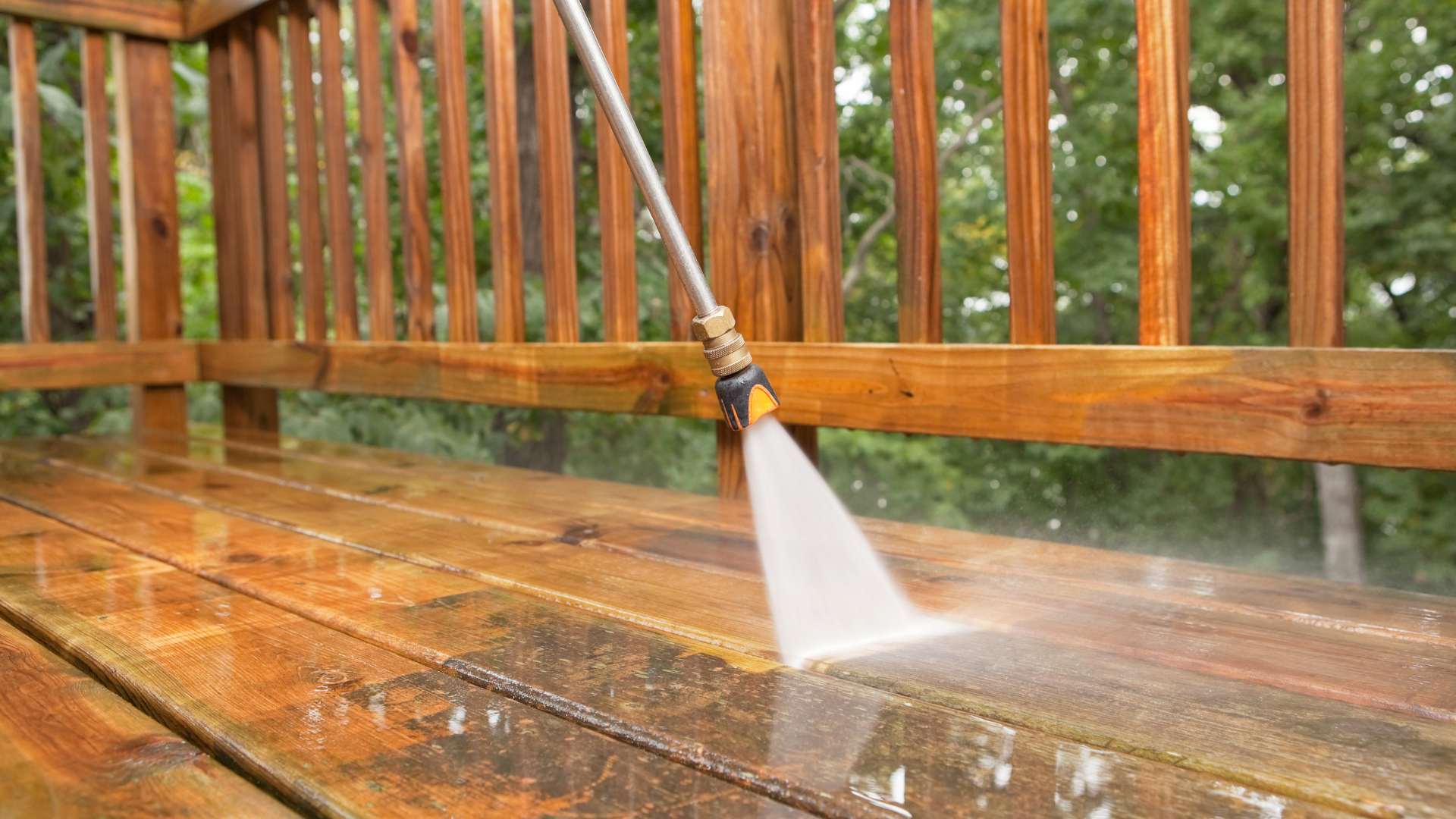
The workhorse for embedded dirt and surface buildup on fences and decks — with the emphasis on calibrated. Moderate pressure, fan tip, moving with the grain: enough force to clear the grain for finish, never enough to gouge softwood or raise fuzz. Wood-safe fence washing is this method practiced as a discipline, and the difference between it and a rental machine at full blast shows up the day the new finish goes on.
Method 2: Chemical Cleaning and Growth Treatment
Where the problem is biological — algae film, mildew spotting — chemistry leads and water follows. Wood cleaners and mildewcides kill growth at the roots so the rinse removes it rather than smearing spores into the grain for a fast return. This is also the method for pre-finish degreasing around grills and high-touch areas where finishes otherwise fish-eye. A note on restraint with chemistry: stronger is not better. Over-concentrated solutions damage wood fibers and lawns alike, and the professional habit worth copying is the patch test — one inconspicuous section, full process, judged dry — before any method runs at full scale.
Method 3: Brightening for Gray Wood
Cleaning cannot fix gray, because gray is not dirt — it is UV-oxidized wood fiber, a surface condition. Oxalic-based brighteners neutralize it, visibly returning boards toward their original tone and balancing pH so the finish absorbs evenly. Any wood that has stood unprotected more than a season or two should assume this step; skipping it is the number one source of blotchy refinishes.
Method 4: Mechanical Prep Where Films Failed
Old failing paint or thick failed coatings are the one case water and chemistry cannot fully solve — loose film must come off mechanically (scraping, sanding) before anything bonds. It is the heaviest prep on this list and the honest reason previously painted wood costs more to refinish, which is itself an argument in the staining-versus-painting decision for wood that still has the choice. Where mechanical prep is unavoidable, restraint is the skill: sand only to remove the failure and feather its edges, never to reshape sound wood, and finish sanding with the grain at moderate grits — over-polished wood closes its own grain and takes penetrating finish poorly, turning yesterday’s paint problem into tomorrow’s absorption problem.
Mistake Signatures: Reading a Failed Prep
Failed prep writes its confession into the finish, and learning the signatures prevents repeats. Finish peeling with gray fuzz on the flake undersides: staining over unremoved dead fiber — the wash or brightener was skipped. Blotchy light-and-dark patches following no pattern: uneven cleaning, or brightener applied to some sections and not others. Fisheyes and beading during application: contamination — grease, sap, or silicone the cleaning never addressed. Finish that looked perfect and failed within a year across the board: almost always moisture, sealed in by finishing before the wood dried. And gouge lines telegraphing through an otherwise sound finish: over-pressure during the wash, permanently recorded. Every one of these traces to a specific skipped or rushed step, which is the encouraging read: refinishing failures are rarely product failures, and the process that prevents them is entirely learnable.
Matching Method to Structure
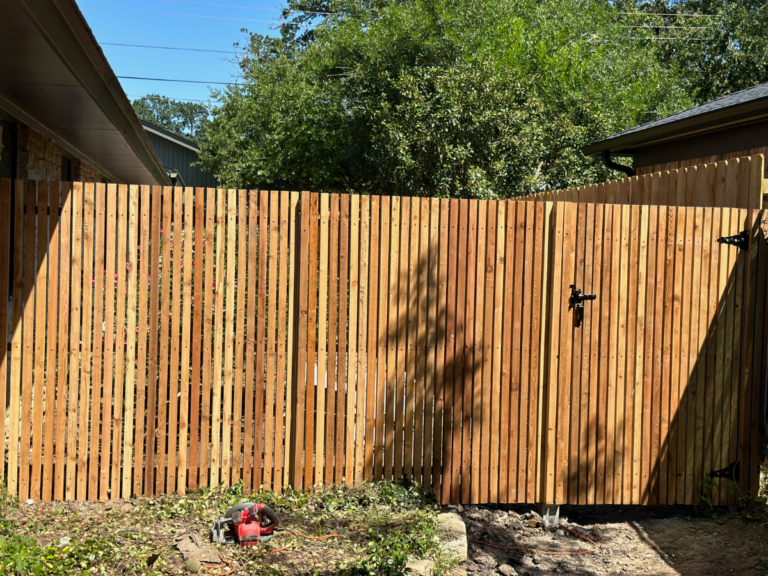
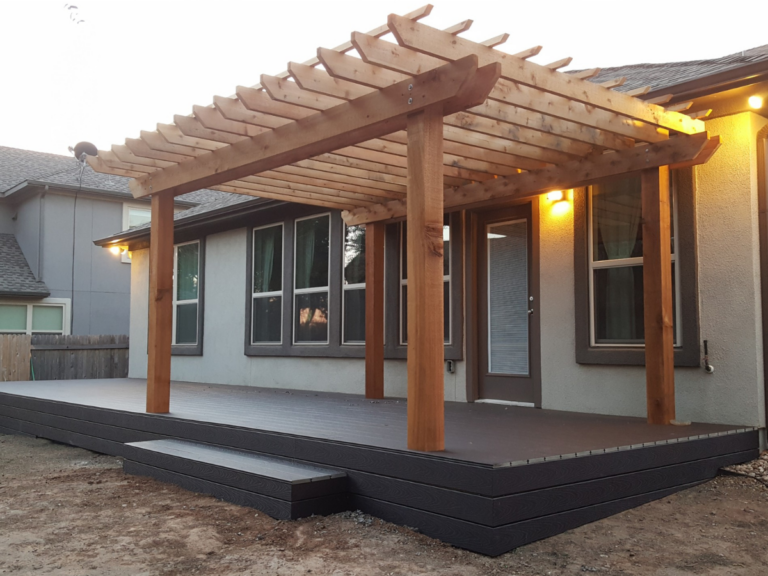
The same methods flex by structure. Fences take the standard pressure-plus-chemistry pairing, with restraint on thin boards. Decks add degreasing around living areas and extra attention to end grain and stair treads. Pergolas run the gentlest calibration on the property — overhead work with drip control, where chemistry carries the most load. And gates, playsets, and small pieces get hand-scale versions of everything above, because a lap-mark that vanishes on two hundred feet of fence glares on a garage door panel.
Then: Dry, Verify, Finish
All methods converge on the same gate — clean wood, dried to the right moisture reading, confirmed with a bead of water or a meter rather than optimism. From there the finish finally gets the surface it was formulated for, and every hour spent on the methods above gets repaid in years of finish life. Prep is not the chore before the project; on refinishing work, prep is the project.
The Pre-Finish Checklist
Compressed to a card: probe for structural issues and replace what fails. Diagnose the surface — palm test, bead test, and a close look at what is actually on the boards. Clean by the matched method: calibrated pressure for buildup, chemistry for growth, degreaser where needed. Brighten any gray. Sand only raised grain and film failures. Clear gaps and corners of debris. Dry two to three days minimum and verify — meter or bead test — before opening anything. Check the forecast for the cure window. Then finish, thin coats, with the grain, wet edge maintained. Ten lines, and every refinishing disappointment we are called to rescue violated at least one of them. Tape it inside the garage door; it outperforms most product upgrades.
FAQs
Which method does my fence need?
Usually pressure plus chemistry, with brightening if any gray shows. The palm test and bead test sort it in two minutes.
Can I skip straight to sanding instead of washing?
Sanding without washing grinds the dirt in and clogs paper instantly. Wash first, sand only where films failed or grain raised.
How soon after cleaning can finishing happen?
After two to three dry days, verified by moisture reading — the universal gate no method exempts you from.
Does new wood need any of this?
New wood needs drying time and a light clean of construction dust, then finishing. The heavy methods are for wood with history.
Is this the same prep for stain and paint?
The cleaning is identical; paint adds the mechanical film-removal burden when it fails later. One more quiet vote for stain. And a practical note for mixed properties: where painted trim meets stainable fence or deck wood, prep each surface by its own rules and mask the boundary — the cleaning chemistries are compatible, but the finishing systems are not, and crisp lines at the transition are what make the whole project read professional.
How long can cleaned wood wait before finishing?
Days comfortably, weeks at a stretch — but past a few weeks outdoors, buildup and UV exposure restart and a light re-clean is honest insurance.
Do these methods differ for hardwood decking like ipe?
The sequence holds; the products adjust. Dense hardwoods want cleaners and finishes formulated for low-porosity wood, and they punish skipped prep even faster than softwoods.